
Geomagnetic storm forecast - 30th March 2026
What Has Happened?
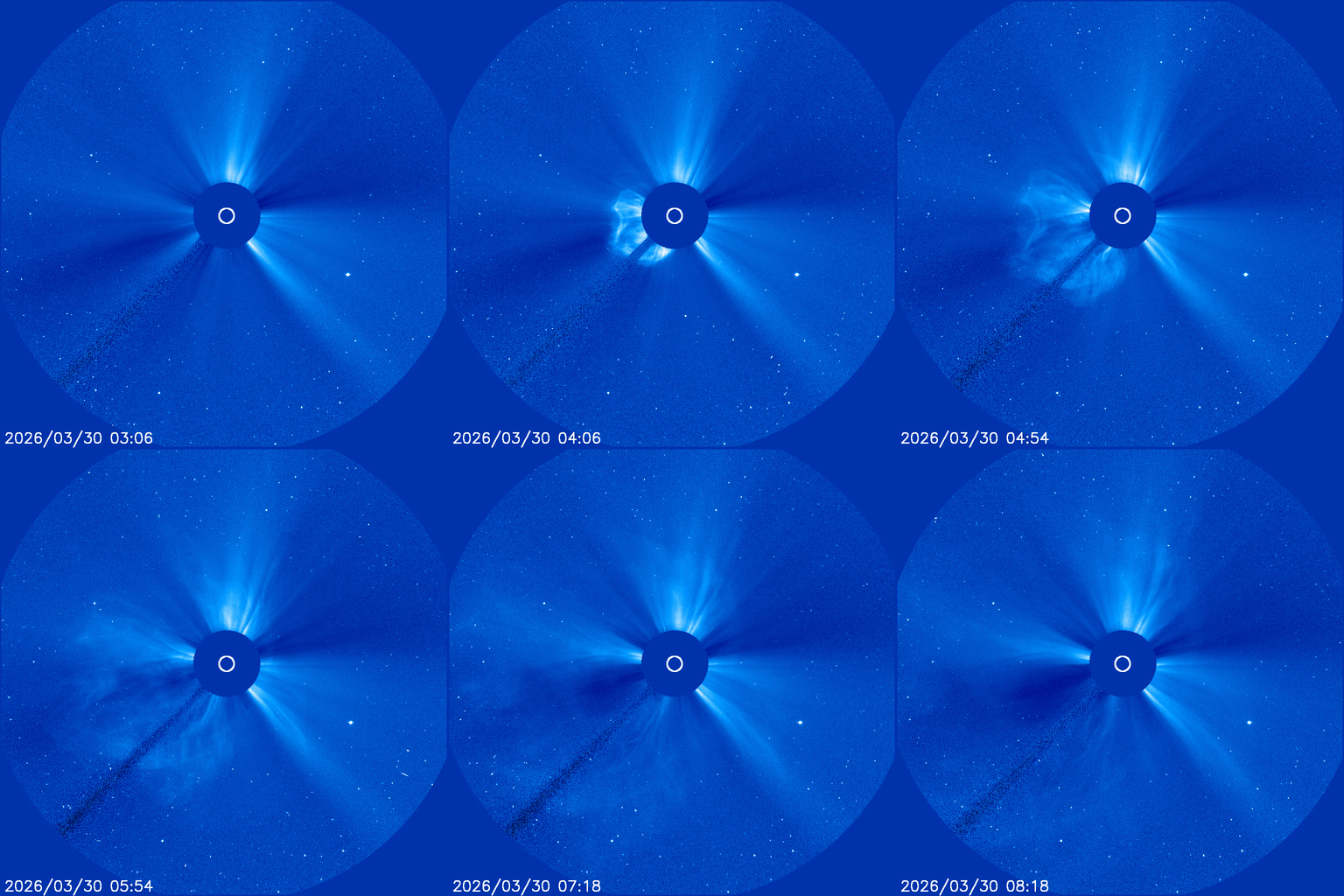
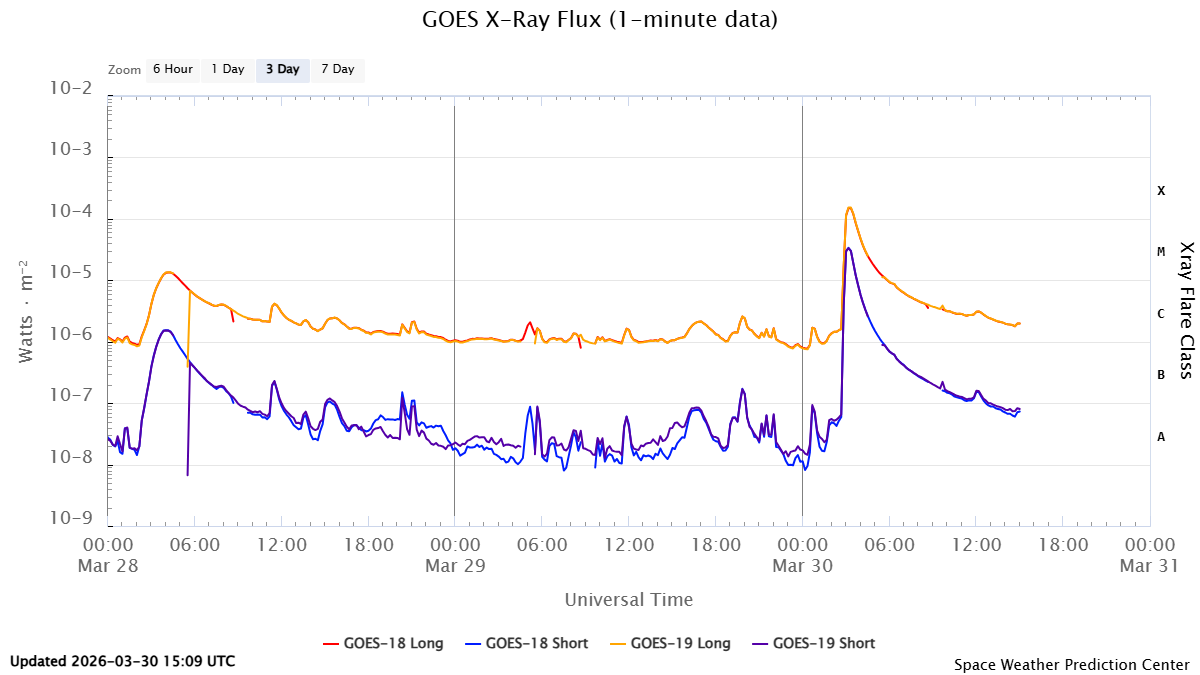
We are expecting an increase in geomagnetic activity from tomorrow, 31st March, due to increased solar activity and coronal hole effects.
An asymmetric full-halo coronal mass ejection (CME) left the Sun at approximately 03:30UT on the 30th March 2026. It was associated with a long-duration X1.4-class solar flare originating from an Earth-facing active region. Modelling suggests the bulk of the ejecta may not be fully Earth directed, however there is a chance of a glancing blow.
The CME is expected to arrive from around midday on the 31st March 2026 and is likely to lead to an enhancement in geomagnetic activity, making STORM periods likely over the next day or two. Activity up to STORM G3 is forecast. Additionally, a high-speed solar wind stream from a coronal hole is expected to arrive from the 2nd April onward with the potential for further STORM periods (up to STORM G1/G2). This high-speed solar wind stream may interact with the CME enroute increasing uncertainty over the strength and duration of STORM activity.Assuming clear dark skies, there is an increased chance of seeing the aurora tomorrow and over the next few days. Those in Scotland, northern England and Northern Ireland have the best chance if the weather is favourable, however illumination from the full moon may also affect visibility.
Sign-up to receive Geomagnetic Storm Forecast emails.
Follow us on Twitter:
Follow @BGSauroraAlert for more occasional aurora alerts.
Follow @BGSspaceWeather for daily space weather forecasts.
Glossary
- BGS
- The British Geological Survey is a geoscience research centre that is part of UK Research and Innovation (UKRI) and affiliated to the Natural Environment Research Council (NERC).
- CME or Coronal Mass Ejection
- The eruption of a portion of the outer atmosphere of the Sun into space, caused by rapid changes in its magnetic field. Often occurs along with a solar flare.
- Solar Flare
- Energy released by the explosive reorganisation of magnetic fields within the Sun's atmosphere.
- Coronal Hole
- A region in the Sun’s outer atmosphere (corona) where hot material can flow unrestrained by its magnetic fields out into space.
- Solar Wind
- The ever-present expansion of the Sun’s hot outer atmosphere into the solar system, which carries space weather within it.
- High Speed Stream
- A fast moving stream of solar wind, responsible for magnetic storms.
- Sunspot/Active Region
- A region of intense magnetic field in the Sun's visible outer atmosphere often associated with flares and CMEs.